> ## Documentation Index
> Fetch the complete documentation index at: https://docs.hopae.com/llms.txt
> Use this file to discover all available pages before exploring further.
# Return Data Model
> What we return after User Verification
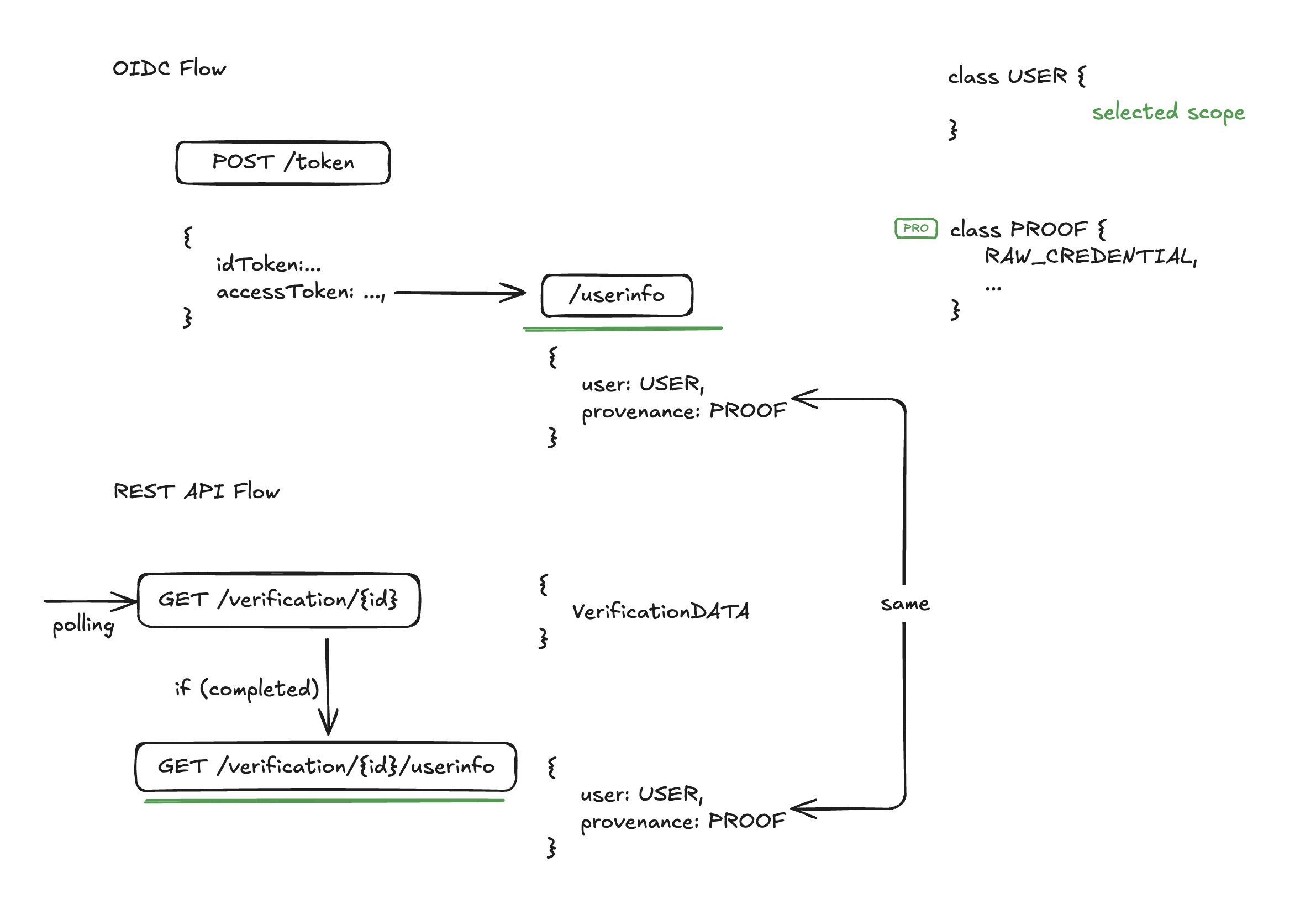 ## Overview
* Who is the user? → returned under `user`.
* How was this identity verified? → described by `provenance`.
* Did the user's claimed values match the source? → returned under `match` for match-capable providers.
## Verification models
The top-level `verification_model` field tells you which payload shape to read:
| `verification_model` | When | Read from | `user` |
| -------------------- | -------------------------------------------------------------------------------------------------------- | ------------------------------- | --------------------------------------- |
| `disclosure` | The provider returned user attributes from an authoritative source. Default for all classic providers. | `user.*` (PII) and `provenance` | object with PII |
| `match` | The provider compared RP-submitted values against the authoritative source and returned a match outcome. | `match.*` and `provenance` | verified subset of the submitted fields |
`verification_model` is always present. Verifications created before this field existed default to `"disclosure"`. `provider_id` mirrors the single element in `amr` and is also always present.
For match flows, `user` echoes back the verified subset of the values you submitted — per-field providers: only fields with `matched: true`; aggregate providers: every submitted field when the aggregate outcome is `true`, otherwise empty. A match provider may additionally expose disclosed (IDP-asserted) claims; those appear under `user` only when requested via `requestedAttributes`, and a requested-but-unavailable disclosed claim is listed in `missing_claims`.
For match-capable providers, `matchData` (the values the RP wants verified) must be supplied at session creation. The keys are **OIDC-normalized** names (see [Normalized User Data](/guides/concepts/normalized-user-data)) and appear back in `match.submitted_fields` and as `match.details` keys. See [Create Verification](/api-reference/verifications/create-verification) (`matchData` body field) and [OIDC Authorization](/api-reference/oidc/auth) (`match_request` JWT param).
## What “Provenance” Means
Provenance explains the verification story — who vouched for the identity, how it was presented, and when it happened.
* Presentation
* Channel: the route and transport (for example, `centralized_idp` over `internet`, `chip_based` via `nfc`, `wallet` over `internet`).
* Credentials\[]: the documents or assertions that were presented (`type` is the provider identifier, alongside issuer details and raw upstream claims).
* Evidence (when provided)
* Evidence is included when the credential provides it; the object relays the upstream `token` payload and a semicolon-delimited `names` list describing the keys. Key names are provider-specific—always read them from `names`. Content is relayed from the credential source.
* Metadata
* Verification identifiers and timestamps for audit and support (`verification_id`, `verified_at`).
### UserInfo Payload Structure
Here is a conceptual map of the UserInfo payload. This tree view shows how the data is organized, with a brief explanation for each major component. For detailed field specifications, refer to the Schema Tables that follow this section.
```jsonc theme={null}
{
// --- Identity ---
"sub": "...", // Subject identifier (stable per source identity)
"provider_id": "smartid", // Provider that authenticated the subject (mirrors amr[0])
"amr": ["smartid"],
"verification_model": "disclosure", // "disclosure" | "match" — always present
"user": { // Personal attributes; for "match", the verified subset of submitted fields
"name": "...",
"birthdate": "..."
},
// --- Assurance ---
"acr": "...",
"hopae_loa": 3,
"hopae_loa_label": "substantial",
"missing_claims": ["email", "address"],
// --- Verification Story ---
"provenance": {
"presentation": {
"channel": { "type": "...", "transport": "..." },
"credentials": [
{
"type": "smartid",
"issuer": { "id": "...", "authority_name": "...", "is_government": false },
// `type` matches the providerId you supplied when creating the session; evidence keys vary per provider
"evidence": {
"token": {
"": "...",
"": "...",
"...": "..."
},
"names": ";;..."
}, // optional, may be absent
"claims": { ... }
}
]
},
"_metadata": { "verification_id": "...", "verified_at": "..." }
},
// --- Match (only when verification_model is "match") ---
"match": {
"matched": true, // aggregate outcome
"granularity": "per_field", // "per_field" | "aggregate"
"submitted_fields": ["name", "birthdate"], // RP-submitted matchData keys (OIDC-normalized)
"details": { // per_field: matched + submitted_value; aggregate: submitted_value only
"name": { "matched": true, "submitted_value": "Test User" },
"birthdate": { "matched": true, "submitted_value": "1990-01-01" }
}
}
}
```
### Match payload example
A complete `/userinfo` response from a match-capable provider:
```json theme={null}
{
"sub": "dZwCCSTLVMlJlXKTgSERCsApC7OUnBKT",
"amr": ["id-nik-match"],
"provider_id": "id-nik-match",
"verification_model": "match",
"hopae_loa": 1,
"hopae_loa_label": "none",
"missing_claims": [],
"user": {
"name": "Test User",
"birthdate": "1990-01-01"
},
"provenance": {
"presentation": {
"channel": { "type": "centralized_idp", "transport": "internet" },
"credentials": [
{
"type": "id-nik-match",
"claims": {
"fullName": true,
"dateOfBirth": true,
"nationalIdNo": true
},
"issuer": {
"authority_name": "Directorate General of Population and Civil Registration (Dukcapil)",
"is_government": true
},
"evidence": {
"token": {
"integrator_jws": "eyJhbGciOiJSUzI1NiIsInR5cCI6...",
"token_type": "integrator"
},
"names": "integrator_jws;token_type"
}
}
]
},
"_metadata": {
"verification_id": "f34e2801c3914b3284f2829ea48eeafc",
"verified_at": "2026-04-26T15:56:11.110Z",
"status": "completed"
}
},
"match": {
"matched": true,
"granularity": "per_field",
"submitted_fields": ["name", "birthdate"],
"details": {
"name": { "matched": true, "submitted_value": "Test User" },
"birthdate": { "matched": true, "submitted_value": "1990-01-01" }
}
}
}
```
For match providers, `provenance.presentation.credentials[].claims` carries the upstream IDP response verbatim — typically per-field confirmation from the source authority. This is the audit trail for what the source agreed with — it is not a duplicate of `match.details`. Note the intentional naming asymmetry: `matchData`, `match.submitted_fields`, and `match.details` use OIDC-normalized keys (e.g. `name`, `birthdate`), while `provenance` claims keep the upstream IDP's native keys (e.g. `fullName`, `dateOfBirth`) so the audit trail stays aligned with the source.
`details` may include keys that are not in `submitted_fields` when the upstream provider emits additional verifier results (e.g., a liveness signal alongside the demographic match outcome).
## Related
* [Data Types — User](/guides/data-types/user)
* [Data Types — Provenance](/guides/data-types/provenance)
* [Level Of Assurance (LoA)](/guides/concepts/assurance)
* [OIDC UserInfo](/api-reference/oidc/userinfo)
* [REST UserInfo](/api-reference/verifications/get-verification-userinfo)
## Next Steps
How OIDC fits into User Verification
Understand the end-to-end lifecycle
## Overview
* Who is the user? → returned under `user`.
* How was this identity verified? → described by `provenance`.
* Did the user's claimed values match the source? → returned under `match` for match-capable providers.
## Verification models
The top-level `verification_model` field tells you which payload shape to read:
| `verification_model` | When | Read from | `user` |
| -------------------- | -------------------------------------------------------------------------------------------------------- | ------------------------------- | --------------------------------------- |
| `disclosure` | The provider returned user attributes from an authoritative source. Default for all classic providers. | `user.*` (PII) and `provenance` | object with PII |
| `match` | The provider compared RP-submitted values against the authoritative source and returned a match outcome. | `match.*` and `provenance` | verified subset of the submitted fields |
`verification_model` is always present. Verifications created before this field existed default to `"disclosure"`. `provider_id` mirrors the single element in `amr` and is also always present.
For match flows, `user` echoes back the verified subset of the values you submitted — per-field providers: only fields with `matched: true`; aggregate providers: every submitted field when the aggregate outcome is `true`, otherwise empty. A match provider may additionally expose disclosed (IDP-asserted) claims; those appear under `user` only when requested via `requestedAttributes`, and a requested-but-unavailable disclosed claim is listed in `missing_claims`.
For match-capable providers, `matchData` (the values the RP wants verified) must be supplied at session creation. The keys are **OIDC-normalized** names (see [Normalized User Data](/guides/concepts/normalized-user-data)) and appear back in `match.submitted_fields` and as `match.details` keys. See [Create Verification](/api-reference/verifications/create-verification) (`matchData` body field) and [OIDC Authorization](/api-reference/oidc/auth) (`match_request` JWT param).
## What “Provenance” Means
Provenance explains the verification story — who vouched for the identity, how it was presented, and when it happened.
* Presentation
* Channel: the route and transport (for example, `centralized_idp` over `internet`, `chip_based` via `nfc`, `wallet` over `internet`).
* Credentials\[]: the documents or assertions that were presented (`type` is the provider identifier, alongside issuer details and raw upstream claims).
* Evidence (when provided)
* Evidence is included when the credential provides it; the object relays the upstream `token` payload and a semicolon-delimited `names` list describing the keys. Key names are provider-specific—always read them from `names`. Content is relayed from the credential source.
* Metadata
* Verification identifiers and timestamps for audit and support (`verification_id`, `verified_at`).
### UserInfo Payload Structure
Here is a conceptual map of the UserInfo payload. This tree view shows how the data is organized, with a brief explanation for each major component. For detailed field specifications, refer to the Schema Tables that follow this section.
```jsonc theme={null}
{
// --- Identity ---
"sub": "...", // Subject identifier (stable per source identity)
"provider_id": "smartid", // Provider that authenticated the subject (mirrors amr[0])
"amr": ["smartid"],
"verification_model": "disclosure", // "disclosure" | "match" — always present
"user": { // Personal attributes; for "match", the verified subset of submitted fields
"name": "...",
"birthdate": "..."
},
// --- Assurance ---
"acr": "...",
"hopae_loa": 3,
"hopae_loa_label": "substantial",
"missing_claims": ["email", "address"],
// --- Verification Story ---
"provenance": {
"presentation": {
"channel": { "type": "...", "transport": "..." },
"credentials": [
{
"type": "smartid",
"issuer": { "id": "...", "authority_name": "...", "is_government": false },
// `type` matches the providerId you supplied when creating the session; evidence keys vary per provider
"evidence": {
"token": {
"": "...",
"": "...",
"...": "..."
},
"names": ";;..."
}, // optional, may be absent
"claims": { ... }
}
]
},
"_metadata": { "verification_id": "...", "verified_at": "..." }
},
// --- Match (only when verification_model is "match") ---
"match": {
"matched": true, // aggregate outcome
"granularity": "per_field", // "per_field" | "aggregate"
"submitted_fields": ["name", "birthdate"], // RP-submitted matchData keys (OIDC-normalized)
"details": { // per_field: matched + submitted_value; aggregate: submitted_value only
"name": { "matched": true, "submitted_value": "Test User" },
"birthdate": { "matched": true, "submitted_value": "1990-01-01" }
}
}
}
```
### Match payload example
A complete `/userinfo` response from a match-capable provider:
```json theme={null}
{
"sub": "dZwCCSTLVMlJlXKTgSERCsApC7OUnBKT",
"amr": ["id-nik-match"],
"provider_id": "id-nik-match",
"verification_model": "match",
"hopae_loa": 1,
"hopae_loa_label": "none",
"missing_claims": [],
"user": {
"name": "Test User",
"birthdate": "1990-01-01"
},
"provenance": {
"presentation": {
"channel": { "type": "centralized_idp", "transport": "internet" },
"credentials": [
{
"type": "id-nik-match",
"claims": {
"fullName": true,
"dateOfBirth": true,
"nationalIdNo": true
},
"issuer": {
"authority_name": "Directorate General of Population and Civil Registration (Dukcapil)",
"is_government": true
},
"evidence": {
"token": {
"integrator_jws": "eyJhbGciOiJSUzI1NiIsInR5cCI6...",
"token_type": "integrator"
},
"names": "integrator_jws;token_type"
}
}
]
},
"_metadata": {
"verification_id": "f34e2801c3914b3284f2829ea48eeafc",
"verified_at": "2026-04-26T15:56:11.110Z",
"status": "completed"
}
},
"match": {
"matched": true,
"granularity": "per_field",
"submitted_fields": ["name", "birthdate"],
"details": {
"name": { "matched": true, "submitted_value": "Test User" },
"birthdate": { "matched": true, "submitted_value": "1990-01-01" }
}
}
}
```
For match providers, `provenance.presentation.credentials[].claims` carries the upstream IDP response verbatim — typically per-field confirmation from the source authority. This is the audit trail for what the source agreed with — it is not a duplicate of `match.details`. Note the intentional naming asymmetry: `matchData`, `match.submitted_fields`, and `match.details` use OIDC-normalized keys (e.g. `name`, `birthdate`), while `provenance` claims keep the upstream IDP's native keys (e.g. `fullName`, `dateOfBirth`) so the audit trail stays aligned with the source.
`details` may include keys that are not in `submitted_fields` when the upstream provider emits additional verifier results (e.g., a liveness signal alongside the demographic match outcome).
## Related
* [Data Types — User](/guides/data-types/user)
* [Data Types — Provenance](/guides/data-types/provenance)
* [Level Of Assurance (LoA)](/guides/concepts/assurance)
* [OIDC UserInfo](/api-reference/oidc/userinfo)
* [REST UserInfo](/api-reference/verifications/get-verification-userinfo)
## Next Steps
How OIDC fits into User Verification
Understand the end-to-end lifecycle